
Brainspotting in Plain-English: A Guide for People Ready to Try Something Different
Mar 06, 2026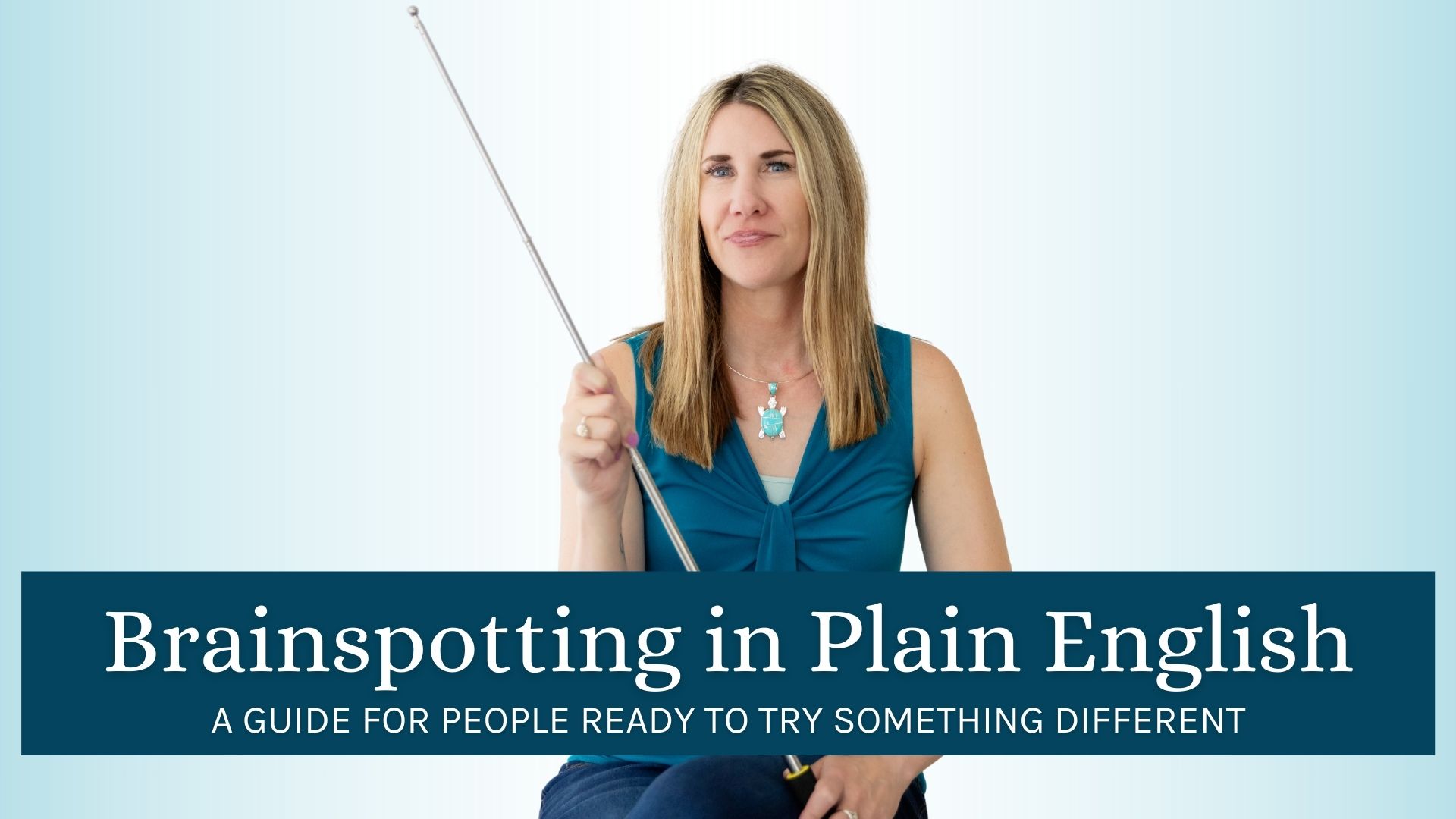
I spent 36 years in therapy.
I started when I was 4, & I just kept going. Through childhood, through school, through building a career & a life. I genuinely believed I had done the work, as I knew myself that I had language for my patterns; I understood, intellectually, where a lot of it came from.
And then my life cracked open in a way I didn't see coming.
My family & I made a cross-country move from Idaho to Wisconsin. New city. New community. Starting over in ways that went deeper than just unpacking boxes. I had lost something that was tied to my identity & my sense of worth in a way that blindsided me. The transition was hard in the kind of way that sits in your chest & doesn't move, no matter how much you talk about it.
A therapist I started seeing suggested Brainspotting.
I had never heard of it. I was a therapist & OT myself & I had never heard of it.
Three sessions later, something that 36 years of counseling hadn't touched was gone.
I want to be careful here because "gone" sounds dramatic. It wasn't like a magic trick. It was more like: I had been bracing for something for so long, I didn't even know I was doing it. & then one day I wasn't. The weight I'd been carrying had shifted in a way that felt quiet & permanent at the same time.
That was about 8 years ago. I've been in the Brainspotting world ever since.
I share that not to sell you on anything, but because I think it matters that you know I'm not someone who read about this & decided to teach it. I'm someone whose life changed because of it. & that changes how I talk about it.
So let me explain what it actually is in plain English. No neuroscience degree required.
Where you look affects how you feel.
That's the whole foundation - Six words.
Brainspotting was discovered by Dr. David Grand, who noticed during EMDR sessions that a client's eye position during processing directly corresponded with what was moving emotionally. He started paying attention to that. He kept following it. & what emerged was an entirely new modality built on one core insight: the visual field is a map. & specific points in that map are access points to where the brain is holding pain, trauma & emotional blocks.
He called those points Brainspots.
When you locate a Brainspot & hold it, the brain gets a direct channel to process what it's been storing, not through talking, not through analysis but through the part of the brain that was holding it in the first place.
Here’s why talking about it isn't always enough.
This is something I wish someone had explained to me during those 36 years of therapy.
The brain has two layers that matter here.
The first is the thinking brain, the neocortex. This is where language lives. Where insight happens. Where you connect the dots, understand your patterns & make sense of your story. Talk therapy works here. It's valuable. It's real. But it has a ceiling.
The second is the survival brain, the subcortical brain, which is the brainstem & limbic system. It's older, deeper & it doesn't speak in words, it speaks in sensation, in body responses, in the tightness in your chest that shows up before you even know why, & in the panic that fires before your thinking brain has caught up.
Trauma, grief, stored emotional pain, these don't live in the thinking brain. They live in the survival brain & the survival brain doesn't respond to reasoning, because it was never a reasoning problem.
This is why you can understand exactly where something came from & still feel completely stuck in it. You're working on the wrong floor.
Brainspotting goes downstairs.
What actually happens in a session?
You sit comfortably. Your practitioner uses a pointer to slowly guide your gaze across your visual field while you tune into a sensation, emotion or topic you're working with.
At a certain point, something shifts. Maybe your eyes flutter, maybe you blink more, maybe there's a subtle change in your breathing or a catch in your body, that's the Brainspot. That's the location in your visual field that corresponds to where your brain is holding the activation.
Your practitioner holds the pointer there. & you just... allow.
You don't have to talk through it. You don't have to relive it. You don't have to find the right words. You just notice what comes up. Sensations. Images. Emotions. Sometimes, nothing that feels like much at all & the brain does what it was always designed to do when it finally feels safe enough.
It processes. It releases. It re-routes.
Some people feel emotional during a session. Some feel physical sensations moving through their body. Some feel surprisingly calm, almost spacey. All of it is normal. All of it is the subcortical brain doing its job.
After a session, it's common to feel a little cloudy or tired. Your brain is still working. Still integrating. Within a day or two, most people notice something lighter. A shift in how they're seeing something. A pattern that isn't firing the way it used to.
That's new synaptic connections forming. That's the brain re-routing away from the old maladaptive pathway.
I've watched this happen in clients for years. I've experienced it myself more times than I can count. It still moves me every time.
Now, I want to answer what Brainspotting is not, because I get these questions a lot. To clarify, it's not hypnosis, & you are fully conscious & in control the entire time.
It's not EMDR, although Dr. Grand discovered it through EMDR, the two are distinct modalities with different mechanisms & applications.
It's not talk therapy with an eye position added on. The absence of required narrative is actually one of the most significant things about it. You don't have to tell the story to heal from it.
It doesn't require you to relive anything. The subcortical brain processes at its own pace, in its own language. Your job is to stay present & curious, not to perform healing.
So who Brainspotting is for? The short answer is: almost anyone carrying something they haven't been able to move.
In my practice, I work with Brainspotting for grief & loss, trauma & PTSD, anxiety, life transitions, neurodivergence, sensory processing, medical anomalies, couples, parts work, spiritual expansion, performers & creatives, & children & teens.
I also work with practitioners who want to add it to their clinical toolkit, including OTs, which I'll talk more about in another post.
If you've done therapy & still feel stuck, Brainspotting might be what you've been missing. Not because therapy didn't work. But because the part that needs healing might not live where therapy was looking.
That was true for me, 36 years in, & three sessions changed something that hadn't budged in all that time.
A note on finding a practitioner.
Brainspotting is practiced by licensed professionals who have completed Phase 1 training at a minimum. If you're looking for a practitioner, look for someone who is Phase 1 trained or higher. Certified Consultants have completed a more rigorous track & can also support other clinicians through the certification process.
If you're curious about working with me directly, whether as a client or as a practitioner seeking consultation, you can find more information here.
👉 Learn more about Brainspotting sessions
Heather Corbet is a Certified Brainspotting Consultant, Specialty Workshop Presenter, Assistant Phase 1 Trainer in Schools & Reiki Master Teacher. She holds a Bachelor's in Psychology & a Master's in Occupational Therapy & has been practicing for over 25 years.
Don't miss out on your emails!
Join the list to receive the latest news and updates.
Don't worry, your information will not be shared.
By signing up, you agree that you may receive occasional promotional e-mail messages with offers, updates, & messages. Feel free to unsubscribe at any time!
